
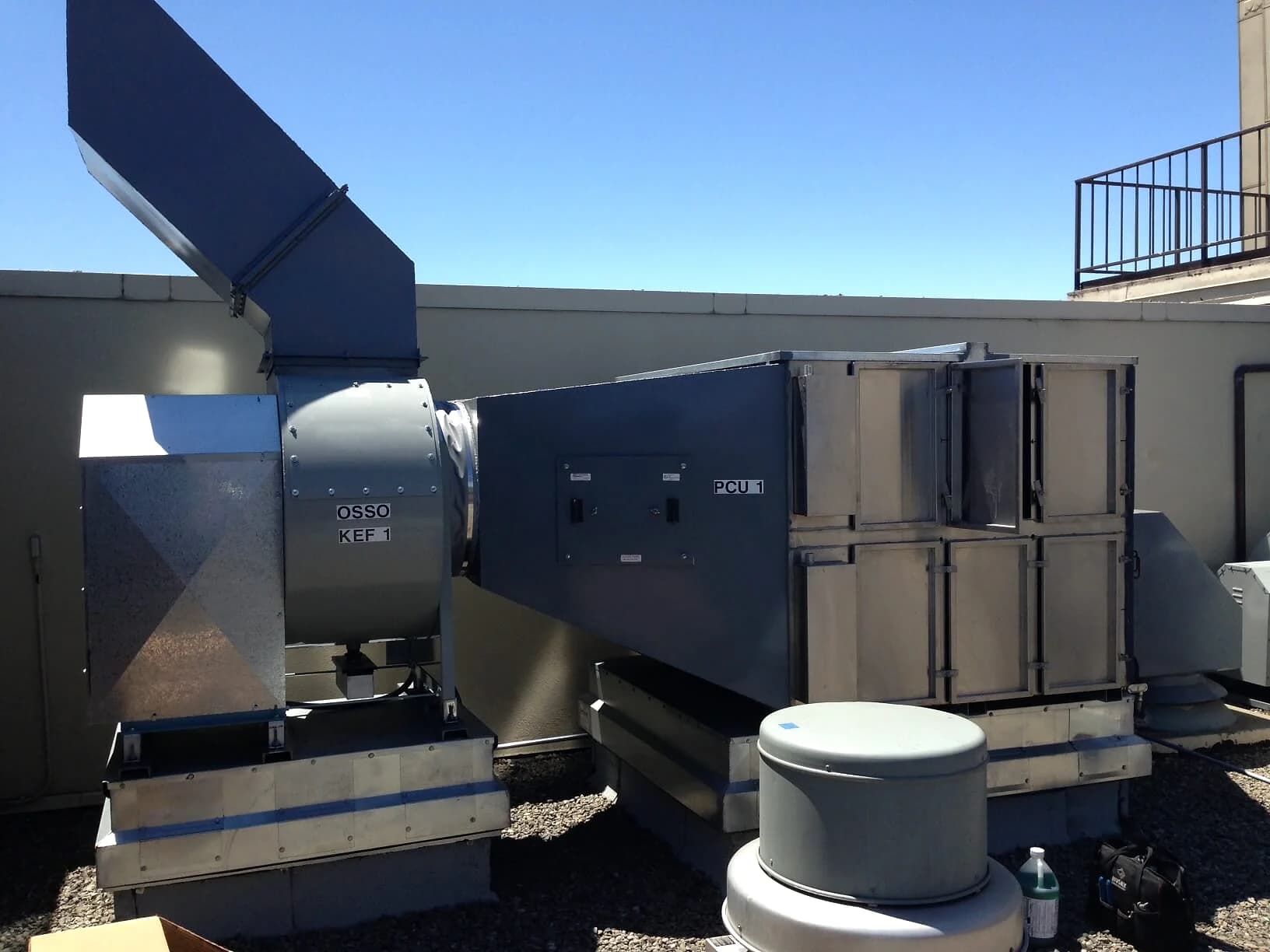
Where PCU sits in the duct path
The Pollution Control Unit sits in the grease duct run between the kitchen hood and discharge, before the fan in the documented arrangement. It provides dry filtration for smoke particulate and grease vapor from commercial cooking. Indoor or outdoor placement is possible, subject to the project’s environmental and installation requirements.
The enclosure uses 18-gauge Type 304 stainless steel with removable gasketed access doors. Its three stages are a MERV 9 pre-filter, a MERV 14 high-efficiency stage, and a MERV 14 or optional carbon final stage. Select the model and filter arrangement for the actual airflow and cooking operation.
Coordinate space, resistance and service
PCU’s basic enclosure length is 63 inches; width follows the selected model. Allow at least 30 inches on the service-access side and coordinate the other documented clearances. Doors, filter removal and the route used by service personnel need to remain accessible after installation.
The initial PCU resistance is 1.54 inches water gauge. Exhaust-fan selection must also account for hood, duct and other system losses. Coordinate support, drains, monitoring and fire-suppression provisions with the project team using the current manual.
Address odor as a separate requirement
Reducing grease vapor and particulate does not resolve every odor concern. Optional carbon in PCU’s final stage or a MOAS odor-abatement system may be considered for the particular exhaust and discharge conditions.
MOAS uses two remote nozzle assemblies to mist neutralizing solution into the grease duct while keeping its cabinet outside the duct. Its odor treatment relies on chemical neutralization, not an odor-removal filter or perfume. Share the complete hood-to-discharge layout so nozzle placement, filtration, service access and project responsibilities can be reviewed together.