
In short
- A pollution control unit (PCU) treats commercial kitchen exhaust before it leaves the building.
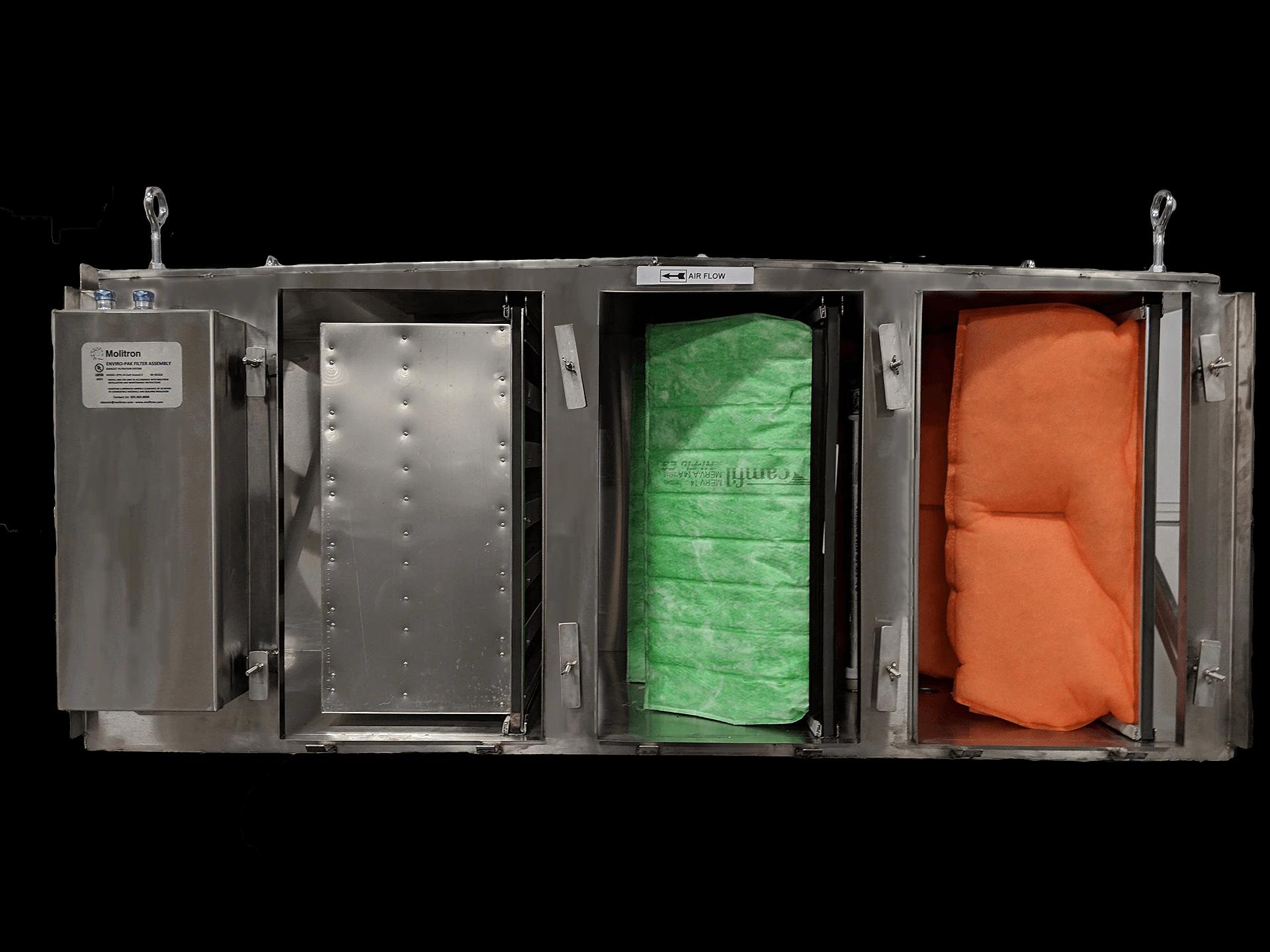
- A MERV 9 pre-filter is followed by a MERV 14 high-efficiency stage, with MERV 14 media or optional carbon in the final stage.
- Molitron’s PCU comes in eleven models, EPFA-24 through EPFA-144, with capacities from 1,800 to 10,800 CFM.
- Inspect and service the filters every four weeks, and respond promptly to a blinking red service light.
What a pollution control unit does
The Pollution Control Unit contains three dry filter stages in an 18-gauge Type 304 stainless-steel enclosure between the kitchen hood and discharge.
A MERV 9 pre-filter is followed by a MERV 14 high-efficiency stage, with MERV 14 media or optional carbon in the final stage. The optional carbon final stage replaces the third stage; it does not add a fourth. Filtration requires no process water, circulation pumps or chemical dosing.
The exhaust path, left to right: the cooking line under its hood; the duct; the PCU in the duct after the hood; two MOAS misting nozzles on opposite sides of the duct, after the PCU outlet and ahead of the exhaust fan; the exhaust fan; and the discharge. The MOAS cabinet is on the wall with its solution container below it, joined by a pipe; compressed air reaches both nozzles in the black line and solution in the red line. Highlighted: the PCU.
PCU’s standard stages filter smoke particulate and grease vapor; standard filtration isn’t comprehensive odor removal.
Where it is installed
The PCU goes in a convenient location between the cooking hood and the exhaust fan, either on the roof or suspended inside the building. The PCU can be installed indoors or outdoors within the exhaust path, subject to project-specific design and installation requirements.
PCU’s basic enclosure length is 63 inches; width follows the selected model. Allow at least 30 inches on the service-access side and coordinate the other documented clearances. Doors, filter removal and the route used by service personnel need to remain accessible after installation.
The initial PCU resistance is 1.54 inches water gauge. Exhaust-fan selection must also account for hood, duct and other system losses.
| Basic enclosure length | 63 inches |
|---|---|
| Service-access side | at least 30 inches |
| Initial PCU resistance | 1.54 inches water gauge |
Sizing
Molitron’s PCU comes in eleven models, EPFA-24 through EPFA-144, with capacities from 1,800 to 10,800 CFM. The model suffix identifies the width, from 24 to 144 inches; final model selection depends on the project.
Units can be stacked for more airflow on the same footprint. Stacked arrangements, their supports and ductwork are designed for each project. Call Molitron for higher CFMs.
| Models | EPFA-24 through EPFA-144 |
|---|---|
| Capacities | 1,800 to 10,800 CFM |
Monitoring and filter service
The status panel is standard equipment. We recommend a visible location in the kitchen or GM’s office. A green light means the fan is on. A blinking red light means inspect the filters and replace them as needed.
Inspect and service the filters every four weeks, and respond promptly to a blinking red service light. Four weeks is an inspection interval, not a guaranteed filter life.
A trained HVAC technician must be present for installation and startup. Ongoing service and maintenance can be performed by a trained HVAC technician or trained kitchen staff.
Listing and project approval
PCU is UL Listed under File MH45752. Models EPFA-24 through EPFA-144 were investigated to the UL 8782 Outline of Investigation for Pollution Control Units for Commercial Cooking Operations.
A product listing does not establish project approval, code compliance, accessory coverage, field-installation acceptance, or suitability for a specific application. The project team and authority having jurisdiction retain their respective roles.

PCU · UL Listed
File MH45752 · Covered EPFA models, 24–144 in. wide.
Scan the QR code or view the UL listing online.
The equipment listing applies to covered models. Project requirements and installation approval remain site-specific.
When odor is the problem too
For odor, PCU offers an optional carbon final stage for a project-specific objective, or you can pair it with MOAS.
The Molitron Odor Abatement System mists Odor Neutralizer Solution through nozzles in the exhaust. Chemical neutralization changes odor compounds rather than covering them with perfume. This odor-treatment step uses no disposable filters and creates no spent-filter waste.
MOAS is ETL Listed for the United States and Canada under Intertek Report 101453585DEN-002, which identifies UL 197 and CSA C22.2 No. 109.
Use either one alone, or both together.
 Scan U.S. ETL recordScan or open the MOAS U.S. ETL record with Intertek (opens in a new tab)
MOAS · ETL Listed
United States and Canada · Intertek Report 101453585DEN-002.
U.S. ETL recordCanadian ETL record
The equipment listing applies to MOAS. Project requirements and installation approval remain site-specific.
Ask for a quote
- Send the appliance list, airflow, hood and duct plans, discharge location and available equipment space.
- Include service access and project requirements so Molitron can discuss the combination with the design team.
Final fit, configuration and results remain project-specific. We reply the same business day, and within one business day at most.